PD 3.1 140W vs 65W USB-C Charging: What Importers Should Know
For B2B buyers, the difference between 65W and PD 3.1 140W USB-C charging is mainly product positioning. A 65W port is suitable for phones, tablets, handheld gaming devices and many lightweight laptops. A PD 3.1 140W port is designed for higher-power laptops and users who want faster charging from a single USB-C port. A desktop charging station with both 140W and 65W outputs can serve more device categories from one product.
This is why high-power GaN desktop chargers are becoming attractive for wholesalers, electronics retailers and private-label accessory brands.
Simple Answer: When Is 65W Enough?
65W is enough for many common devices:
- Smartphones
- Tablets
- Earbuds and accessories
- Handheld gaming devices
- Some ultrabooks and small laptops
- Built-in cable charging for daily desk use
For retail positioning, 65W is easy to explain as "fast charging for phones, tablets and many laptops." It is also a useful output level for built-in retractable USB-C cables because users can charge many devices without carrying another cable.
When Does PD 3.1 140W Matter?
PD 3.1 140W matters when the customer uses a high-power USB-C laptop or wants a premium charging setup. A 140W port gives the product stronger value for:
- MacBook Pro users
- Creative professionals
- Office workstations
- IT equipment rooms
- Multi-laptop households
- Premium electronics bundles
For importers, 140W support helps move the product out of the low-price phone charger category and into the higher-value workstation accessory category.
Why Multi-Port Power Distribution Is Important
Many buyers look only at the total wattage, but multi-port behavior is what customers experience every day. A charger may advertise high total power, but the real question is how much power each connected device receives.
For a 6-port desktop charger, buyers should ask:
- What is the maximum output of USB-C1?
- What is the maximum output of USB-C2?
- What happens when two laptops are connected?
- What happens when all USB-C and USB-A ports are used?
- Does the built-in cable have a fixed maximum wattage?
- Does the display show real-time voltage, current and wattage?
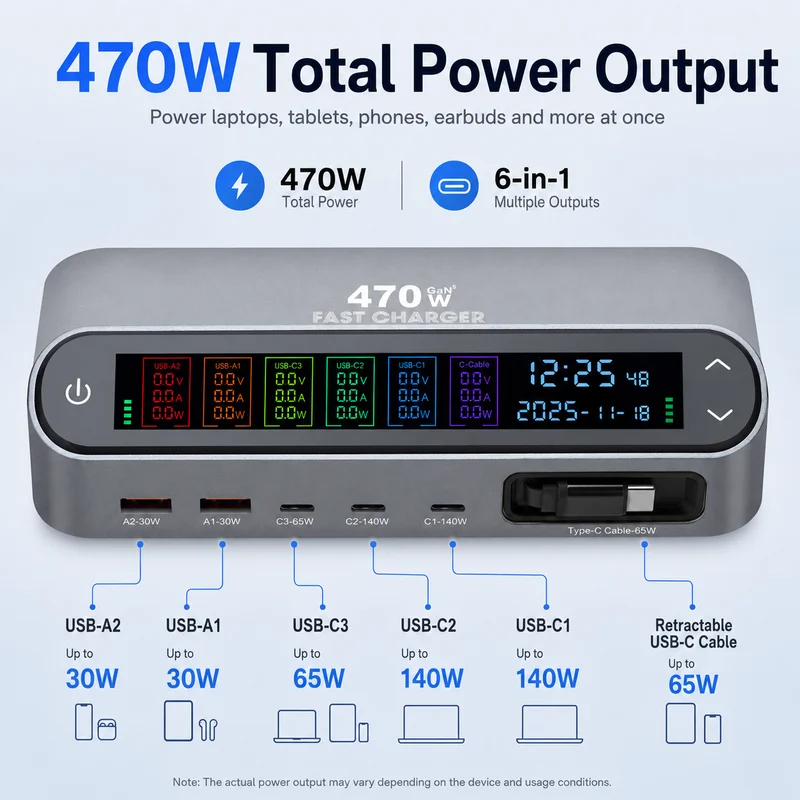
The Doolike 470W GaN desktop charger uses dual 140W USB-C ports, one 65W USB-C port, two 30W USB-A ports and a built-in 65W retractable USB-C cable. See the detailed model page: 470W GaN desktop charger with dual 140W PD 3.1 ports.
65W vs 140W Comparison Table
| Feature | 65W USB-C | PD 3.1 140W USB-C |
|---|---|---|
| Main use | Phones, tablets, light laptops | High-power laptops and workstation users |
| Product tier | Mid-range fast charging | Premium laptop charging |
| B2B selling angle | Everyday multi-device charging | Full-speed laptop charging and professional desk setup |
| Best placement | Built-in cable or secondary USB-C port | Main USB-C ports |
| Buyer question | "Can it charge my phone/tablet?" | "Can it charge my laptop fast enough?" |
How Importers Can Position a 470W Charger
A 470W desktop charger should be positioned as a workstation charging hub, not as a simple phone charger. Recommended positioning:
"One desktop charging station for laptops, tablets, phones and accessories, with dual PD 3.1 140W USB-C ports and a built-in retractable 65W USB-C cable."
Procurement Checklist
Before ordering a 140W desktop charger, importers should confirm:
- PD 3.1 output details.
- Cable and port wattage ratings.
- Power distribution with multiple devices connected.
- Certification files for the target market.
- Sample availability.
- Heat performance under load.
- Packaging and user manual options.
- Warranty and after-sales policy.
FAQ
Is 140W charging always faster than 65W?
Only if the device supports higher-power USB-C charging. A phone will not use 140W just because the charger supports it. The charger and device negotiate the correct charging level.
Should wholesalers choose 65W or 140W chargers?
Wholesalers should carry both if they serve different customer tiers. 65W products fit everyday charging, while 140W products fit premium laptop and workstation charging.
Why do desktop chargers use several output levels?
Different devices need different power levels. A desktop charging station can use high-power ports for laptops and lower-power ports for phones, accessories and tablets.
Is total wattage the same as single-port wattage?
No. Total wattage is the combined rated output. Single-port wattage is the maximum power one port can provide. B2B buyers should check both.
Is a real-time display useful?
Yes. A display showing voltage, current and wattage helps users see how each port is performing. It is also a strong retail demonstration feature.