Por qué el calibre del cable (AWG) es importante para la velocidad de carga USB
Al adquirir cables USB al por mayor, la mayoría de los compradores se centran en el tipo de conector, la longitud y la marca. Pero hay una especificación oculta que afecta directamente al rendimiento de la carga: la clasificación American Wire Gauge (AWG). Comprender el AWG puede marcar la diferencia entre un cable que ofrece carga rápida de 65W y uno que se reduce a 10W, incluso si parecen idénticos.
En esta guía, desglosamos la relación entre el calibre del cable y la velocidad de carga, explicamos qué especificaciones AWG debe solicitar a los proveedores y proporcionamos recomendaciones prácticas para la adquisición de cables USB al por mayor en 2026.
¿Qué es el AWG y cómo afecta a la carga?
AWG (American Wire Gauge) es un sistema estandarizado de medición del diámetro del cable. La regla clave: cuanto menor sea el número AWG, más grueso será el cable y menor resistencia eléctrica tendrá. Menos resistencia significa que llega más energía a su dispositivo.
Resistencia AWG y pérdida de energía
Cada cable tiene una resistencia interna medida en ohmios por metro. Cuando la corriente fluye a través del cable, parte de la energía se convierte en calor; esto es pérdida de energía. Para la carga rápida (especialmente USB Power Delivery a 100W+), incluso pequeñas diferencias de resistencia crean caídas de tensión significativas.
- 28 AWG (fino): ~0,225 Ω/m — adecuado solo para transferencia de datos, deficiente para carga superior a 15W
- 24 AWG (estándar): ~0,087 Ω/m — maneja razonablemente hasta 30W de carga
- 22 AWG (grueso): ~0,055 Ω/m — admite de forma fiable carga rápida de 60W+
- 20 AWG (pesado): ~0,034 Ω/m — ideal para cables USB PD 3.1 de 100W+
Para un cable de 2 metros que carga a 100W (20V/5A), un cable de 28 AWG perdería aproximadamente 11,25W en forma de calor, más del 11% de la potencia total. Un cable de 20 AWG pierde solo unos 3,4W, manteniendo la entrega de energía eficiente.
El problema de la caída de tensión
USB Power Delivery requiere una regulación de tensión estricta. Si la resistencia del cable hace que la tensión caiga por debajo del umbral mínimo del dispositivo, el cargador y el dispositivo negocian un nivel de potencia inferior. Es por eso que un cable barato con cables finos puede hacer que su cargador de 65W se comporte como uno de 15W.
La especificación USB-IF requiere que la caída de tensión se mantenga por debajo de 500mV a la corriente nominal. Para un cable de 5A, eso significa que la resistencia total de ida y vuelta debe ser inferior a 0,1Ω, lo que dicta los calibres mínimos de cable basados en la longitud del mismo.
Requisitos de AWG según el estándar de carga
Diferentes protocolos de carga rápida tienen diferentes requisitos de energía, que se traducen en recomendaciones de calibre de cable mínimo:
USB PD 3.0 (hasta 100W)
A 100W (20V/5A), los cables de alimentación (VBUS y GND) necesitan al menos 20 AWG para cables de hasta 2 metros. Los cables de datos pueden ser más finos, de 28 AWG. La mayoría de los fabricantes chinos de renombre ya utilizan esta especificación, pero los proveedores económicos pueden recortar costes.
USB PD 3.1 (hasta 240W)
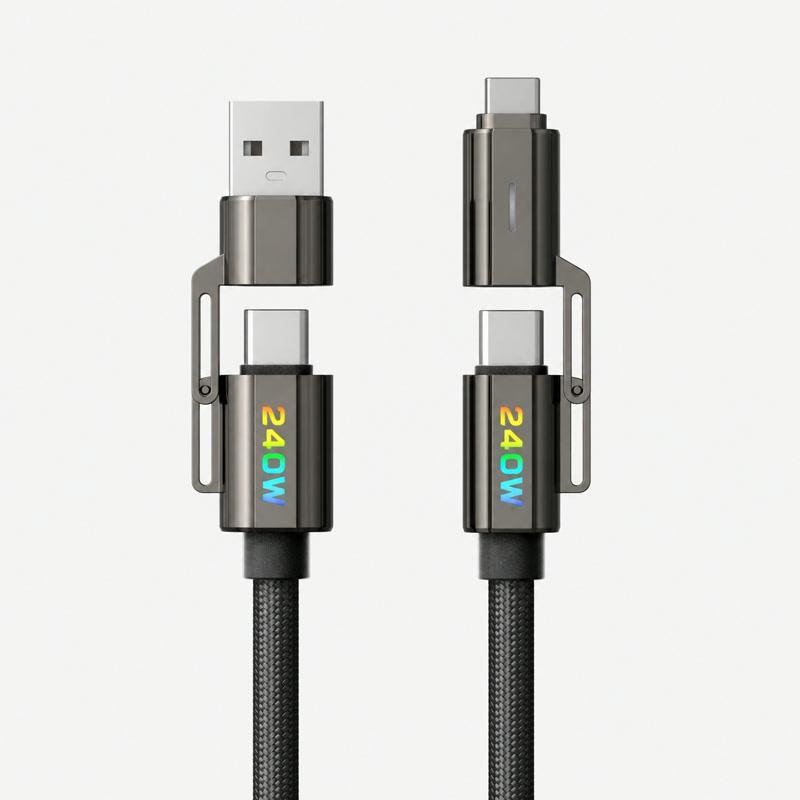
El nuevo estándar EPR (Extended Power Range) de 240W eleva la corriente aún más. Los cables que soportan 240W deben usar 20 AWG o más grueso para los cables de alimentación e incluir un chip e-Marker. Los compradores mayoristas que se dirigen a mercados de portátiles y dispositivos de alto rendimiento deben asegurarse de que sus proveedores de cables incluyan los circuitos integrados (IC) e-Marker adecuados.
Quick Charge 5.0 y VOOC/SuperVOOC
Los protocolos de carga rápida propietarios de Qualcomm (QC 5.0 a 100W+) y OPPO (SuperVOOC a 100W+) también exigen cables de baja resistencia. Estos suelen utilizar configuraciones de pines personalizadas y cables de mayor calibre. Si suministra cables para estos ecosistemas, verifique siempre la especificación AWG con su fabricante.
Comparación de especificaciones AWG para compradores mayoristas
Aquí tiene una tabla comparativa práctica para configuraciones comunes de cables USB mayoristas:
| Tipo de cable | Cables de alimentación | Cables de datos | Potencia máx. | Mejor para |
|---|---|---|---|---|
| USB-C a USB-C (Económico) | 24 AWG | 28 AWG | 30W | Carga básica, cables cortos |
| USB-C a USB-C (Estándar) | 22 AWG | 28 AWG | 65W | Teléfonos, tabletas, uso general |
| USB-C a USB-C (Premium) | 20 AWG | 28 AWG | 100W | Portátiles, carga rápida |
| USB-C PD 3.1 (EPR) | 20 AWG | 28 AWG + e-Marker | 240W | Portátiles gaming, monitores |
| USB-A a USB-C | 24 AWG | 28 AWG | 18W | Dispositivos antiguos, QC 3.0 |
Cómo verificar las especificaciones AWG de los proveedores chinos
Desafortunadamente, muchos fabricantes de cables económicos no etiquetan con precisión el calibre del cable. Aquí le explicamos cómo proteger su inversión mayorista:
Solicite fotos de la sección transversal
Pida a los proveedores que corten un cable y fotografíen la sección transversal. Puede comparar visualmente el grosor del cable. Los cables de alimentación (rojo y negro) deben ser visiblemente más gruesos que los cables de datos (verde y blanco/azul).
Utilice un calibre digital
Para la inspección de calidad de entrada, retire la cubierta del cable y mida el diámetro del cable con un calibre digital. Compare con la tabla de conversión AWG estándar para verificar las afirmaciones.
Pruebe la caída de tensión
Conecte un medidor de potencia USB en la entrada y salida del cable. A 20V/3A (60W), un cable de calidad de 1 metro debería mostrar una caída inferior a 300mV. Si supera los 500mV, es probable que el calibre del cable sea insuficiente.
Longitud del cable frente a AWG: El compromiso
Los cables más largos tienen más resistencia. Para mantener la misma velocidad de carga en longitudes mayores, necesita un cable más grueso (menor AWG). Aquí tiene una guía práctica:
- Cables de 0,5m: Cables de alimentación de 24 AWG suficientes para 60W
- Cables de 1m: Se recomienda 22 AWG para 60W+, 20 AWG para 100W
- Cables de 2m: Se requiere 20 AWG para 60W+, considere cables activos para 100W+
- Cables de 3m+: Deben usar e-Marker activo o híbrido de fibra óptica para carga rápida
Los compradores mayoristas a menudo solicitan cables de 2m como el punto ideal. Asegúrese de que los proveedores utilicen conductores de alimentación de 20 AWG para cables de carga rápida de 2m; esta es la especificación más importante a verificar.
Trenzado frente a no trenzado: ¿El tipo de cubierta afecta al AWG?
El material de la cubierta del cable (PVC, TPE, trenzado de nailon) no afecta directamente al calibre del cable, pero los cables trenzados a menudo pueden acomodar cables más gruesos porque su diámetro exterior ya es mayor. Como cubrimos en nuestra comparación de cables trenzados frente a PVC, los cables trenzados también ofrecen una mejor durabilidad, lo que protege la integridad del cable con el tiempo.
Sin embargo, no asuma que "trenzado" significa automáticamente un mejor AWG. Compruebe siempre la especificación real del conductor, ya que algunos proveedores utilizan cubiertas trenzadas como táctica de marketing mientras mantienen cables finos en el interior.
Implicaciones de costes de los diferentes niveles de AWG
El calibre del cable afecta directamente al coste del mismo. Un cobre más grueso significa más coste de material por metro. Para precios mayoristas en 2026:
- Cables de 28 AWG: 0,15-0,25 $/metro (más baratos, solo datos o carga muy ligera)
- Cables de 24 AWG: 0,25-0,40 $/metro (carga estándar)
- Cables de 22 AWG: 0,35-0,55 $/metro (buena carga rápida)
- Cables de 20 AWG: 0,50-0,75 $/metro (carga rápida premium)
Para un cable típico de USB-C a USB-C de 1m con cables de alimentación de 20 AWG, espere precios FOB de 0,80-1,50 $ por unidad con un MOQ de 500 unidades. Compare esto con 0,30-0,60 $ para cables económicos de 24 AWG; la diferencia de precio es de solo 0,30-0,90 $ por unidad, pero la diferencia de rendimiento es enorme.
Productos relacionados de Doolike
¿Busca adquirir cables USB de calidad con especificaciones AWG verificadas? Doolike ofrece una gama completa de cables USB-C mayoristas y cargadores rápidos GaN fabricados según especificaciones exactas de calibre de cable. También suministramos auriculares TWS y otros accesorios móviles.
Todos los cables Doolike vienen con hojas de especificaciones AWG y pasan las pruebas de cumplimiento USB-IF. Contáctenos para muestras y especificaciones personalizadas.
Preguntas frecuentes
¿Qué AWG debe tener un cable USB-C para carga rápida de 100W?
Para la carga USB PD de 100W, los conductores de alimentación (VBUS y GND) deben ser de al menos 20 AWG. Los cables de datos pueden seguir siendo de 28 AWG. El cable también debe incluir un chip e-Marker para una negociación de energía adecuada.
¿Un AWG más bajo significa siempre un mejor rendimiento de carga?
Un AWG más bajo (cable más grueso) reduce la resistencia y la pérdida de energía, lo que mejora la velocidad de carga. Sin embargo, más allá de cierto punto, se aplican rendimientos decrecientes. Para la mayoría de las aplicaciones de consumo, los cables de alimentación de 20 AWG son óptimos; pasar a 18 AWG añade costes sin beneficios significativos para cables de menos de 2 metros.
¿Cómo afecta la longitud del cable al AWG que necesito?
Los cables más largos tienen una resistencia total mayor. Por cada duplicación de la longitud del cable, aproximadamente se duplica la resistencia. Un cable de 1m con 24 AWG puede funcionar bien para carga de 30W, pero un cable de 2m con 24 AWG perdería el doble de energía. Use 22 AWG o 20 AWG para cables de carga rápida de 2m o más.
¿Puedo verificar las afirmaciones de AWG de un proveedor sin equipo de laboratorio?
Sí. El método más sencillo es utilizar un medidor de potencia USB (disponible por 10-20 $) para medir la caída de tensión bajo carga. Otro enfoque es físico: retire la cubierta del cable y mida el diámetro del cable con un calibre. Un cable de 20 AWG tiene 0,812 mm de diámetro, mientras que el de 24 AWG tiene 0,511 mm.
¿Cuál es el MOQ típico para cables USB con AWG personalizado de fábricas chinas?
La mayoría de los fabricantes de cables chinos requieren un MOQ de 500-1.000 unidades para especificaciones AWG personalizadas. Algunas fábricas ofrecen un MOQ de 200 unidades para configuraciones estándar. Doolike ofrece un MOQ flexible a partir de 300 unidades con documentación completa de especificaciones AWG.
¿Tienen los cables trenzados mejores clasificaciones AWG que los cables de PVC?
No necesariamente. Los cables trenzados tienen un diámetro exterior mayor, lo que puede acomodar cables más gruesos, pero la clasificación AWG depende de la especificación del fabricante, no del material de la cubierta. Solicite siempre la hoja de datos AWG específica en lugar de asumir basándose en el tipo de cable.