80% Charging Limit vs Physical Power Cut Off Adapter
Battery health is no longer a hidden technical topic. Many users now know that staying at 100% charge for long periods can add stress to lithium-ion batteries. That is why phone brands have introduced features such as optimized charging, adaptive charging, charge limits and battery protection modes.
At the same time, a new accessory category is growing: USB-C physical power cut off adapters. These products are designed to disconnect or isolate charging power after full charge. So which is better: an 80% charging limit or a physical power cut off adapter?
The short answer is that they solve related but different problems. A software charging limit is built into the phone. A physical power cut off adapter is an external accessory for compatible USB-C charging setups. For many users, they can work as complementary battery care tools.
What Is an 80% Charging Limit?
An 80% charging limit is a software feature that stops or limits charging around 80% on supported devices. The purpose is to reduce the time a battery spends at a high state of charge. Some devices also use optimized charging, where the phone learns the user routine and delays the final part of charging until closer to wake-up time.
This is useful because it is automatic once enabled. It does not require an extra accessory. It is also built by the device manufacturer, which makes it easy to trust.
However, it has limits. Not every device supports it. Some users do not know how to enable it. Some people still want 100% charge before a long day. Some USB-C devices, such as power banks or accessories, may not have the same battery protection settings.
What Is a Physical Power Cut Off Adapter?
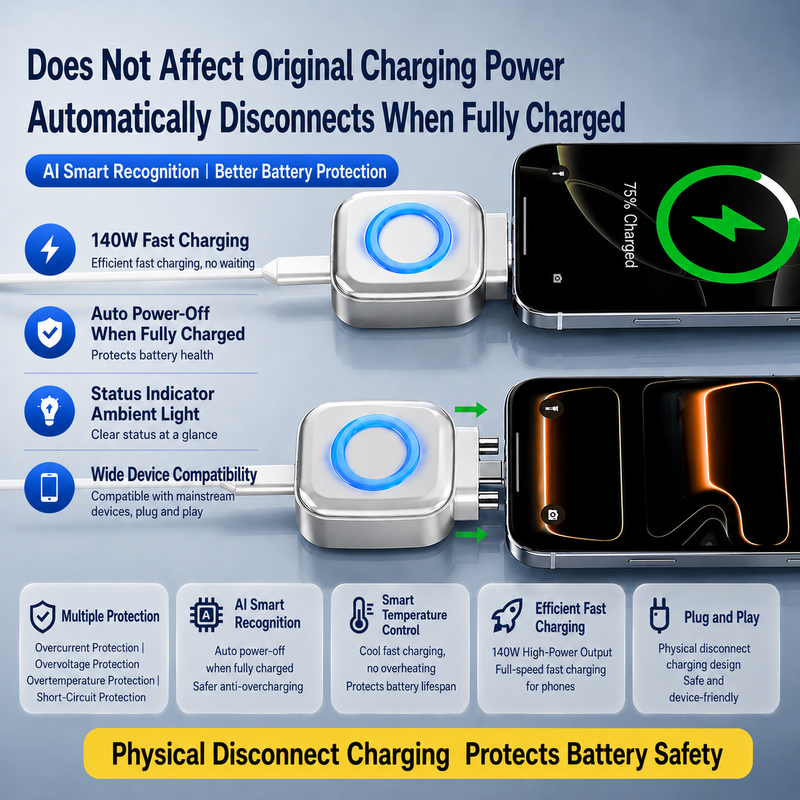
A physical power cut off adapter is a small USB-C accessory placed between the charging cable and the device. It is designed to detect charging status and disconnect or isolate power after full charge.
For customers, the key value is simple: keep using the existing charger and cable, but add a layer of charging protection. For sellers, the product message is strong because it is easy to demonstrate and easy to connect with daily behavior like overnight charging.
Main Differences
Software 80% charging limit:
Built into supported phones
Requires no extra product
Usually limits charging before the battery reaches 100%
Best for users who want daily long-term battery care
Depends on device support and user settings
USB-C physical power cut off adapter:
External charging accessory
Works with compatible USB-C setups
Designed to disconnect or isolate power after full charge
Easy to sell as an overnight charging protector
Can be used across more device categories depending on compatibility
Which One Is Better?
For maximum battery health control, an 80% charging limit is excellent when the user has it and wants to use it. It can reduce high-charge exposure during daily use.
For convenience and wider accessory use, a physical power cut off adapter is easier to explain to buyers who still want to charge to full but do not want the device connected to power all night. It is especially useful as a retail product because it answers a clear concern: what happens after my device is fully charged?
The better question is not “which one replaces the other?” The better question is “which one fits this user's charging behavior?”
When to Recommend an 80% Charging Limit
Recommend software charge limits when the user mainly wants to preserve battery health and does not need full capacity every day. This is common for people who work near a charger, use a phone mostly indoors, or replace devices less often.
When to Recommend a Physical Power Cut Off Adapter
Recommend a USB-C physical power cut off adapter when the user charges overnight, wants a full battery in the morning, uses several USB-C devices, or wants an easy plug-and-play charging protector.
This accessory also fits buyers who do not trust themselves to adjust settings or who buy accessories for family members, hotels, offices, retail bundles or travel kits.
How Sellers Can Position the Product
Do not position the adapter as a magic battery repair tool. That can sound exaggerated. Position it as a smart charging protection accessory that helps reduce unnecessary power connection after full charge.
Good sales phrases include:
Full charge auto disconnect
Physical power cut off adapter
Battery health charging protector
Overnight charging protection
Type-C power isolation adapter
140W USB-C fast charging support
Smart charging disconnect device
FAQ
Does an 80% charging limit charge my phone slower?
Not exactly. It usually limits or stops charging at a lower level. Some optimized charging modes also delay the final charging stage based on user routine.
Can a physical power cut off adapter help if I charge to 100%?
Yes, that is its main selling point. It is designed for users who still want full charge but want to reduce unnecessary power connection after the device is fully charged.
Can both be used together?
In many cases, yes. The software feature manages the phone charging behavior, while the external adapter adds an accessory-level protection layer for compatible charging setups.
Conclusion
An 80% charging limit is a strong built-in battery health feature. A USB-C physical power cut off adapter is a practical external accessory for users who want simpler overnight charging protection and full-charge auto disconnect. For wholesalers, both concepts are useful because they educate customers and create demand for battery health charging accessories.
References
Apple Support: https://support.apple.com/en-us/106348
Google Pixel Help: https://support.google.com/pixelphone/answer/7106961
Samsung Battery Protection: https://www.samsung.com/sec/support/galaxy-battery/battery-protection-tip